

Modern CNC machines are becoming increasingly sophisticated. Multi-axis machining, mill-turn operations, and automated production systems offer tremendous capabilities—but they also introduce greater complexity.
As machine complexity increases, so does the importance of validating CNC programs before they reach the shop floor.
This is where real NC code simulation plays a critical role.
What Is Real NC Code Simulation?
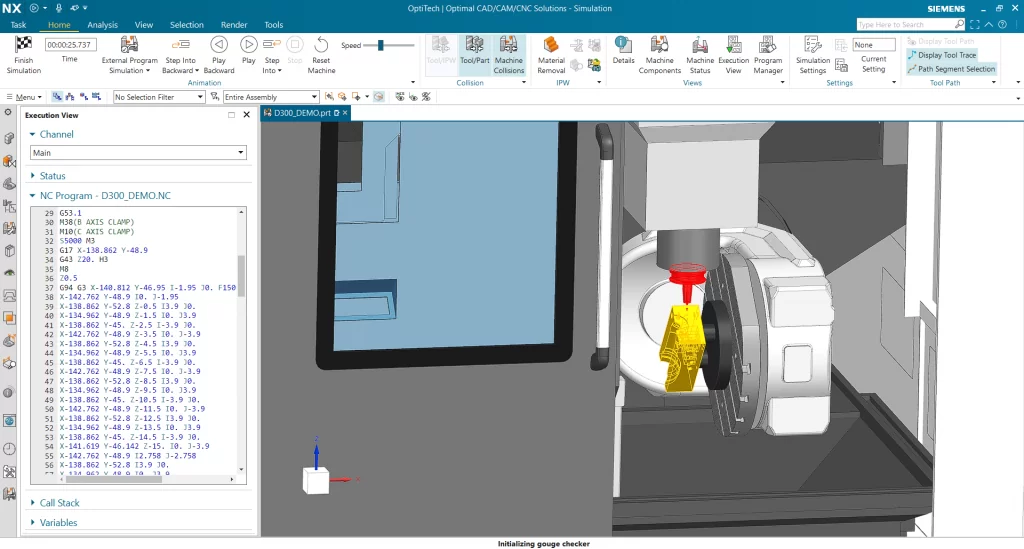
Real NC code simulation is the process of simulating the actual NC program that will run on the CNC machine.
Instead of simulating only CAM toolpaths, the simulation uses the NC code generated by the postprocessor and verifies how the machine will behave when executing that code.
This allows programmers to see machine movements before running the program on the real machine.
Why Isn’t Toolpath Verification Enough?
Many CAM systems provide toolpath verification.
Toolpath verification is useful for checking material removal and machining strategy, but it does not always reflect what happens after the program is processed into NC code.
Between the CAM toolpath and the CNC machine, there is an important step:
The postprocessor.
The postprocessor converts CAM operations into machine-specific NC code, and this conversion can introduce changes that are not visible in a standard toolpath simulation.
As a result, a toolpath may appear correct in CAM while unexpected machine behavior occurs during machining.
What Can Real NC Code Simulation Detect?
Real NC code simulation helps identify issues before production, including:
- Potential machine collisions
- Unexpected axis movements
- Machine limit violations
- Incorrect tool positions
- Setup-related risks
- Postprocessor-related issues
Detecting these problems in a virtual environment is significantly less expensive than discovering them on the machine.
Frequently Asked Questions
Is real NC code simulation the same as machine simulation?
Not always.
Some machine simulations only replay CAM toolpaths. Real NC code simulation specifically uses the NC code generated by the postprocessor.
Do I need real NC code simulation for 3-axis machining?
It can still provide value, but the greatest benefits are typically seen in 5-axis, mill-turn, and other complex machine configurations.
Can simulation guarantee that a crash will never happen?
No simulation can eliminate every possible risk. However, real NC code simulation can significantly reduce the likelihood of programming-related issues reaching the machine.
Conclusion
Real NC code simulation helps bridge the gap between CAM programming and real-world machining.
By validating the actual NC code before production, manufacturers gain greater confidence in their programs, reduce programming risks, and improve overall machining reliability.
As CNC machines continue to become more advanced, real NC code simulation is increasingly viewed as an essential part of the digital manufacturing process.